"There's a difference between doing things right and doing the right thing. The curious thing is — the righter you do the wrong thing, the wronger you become."— Peter Drucker, as cited in Haynes (2010)

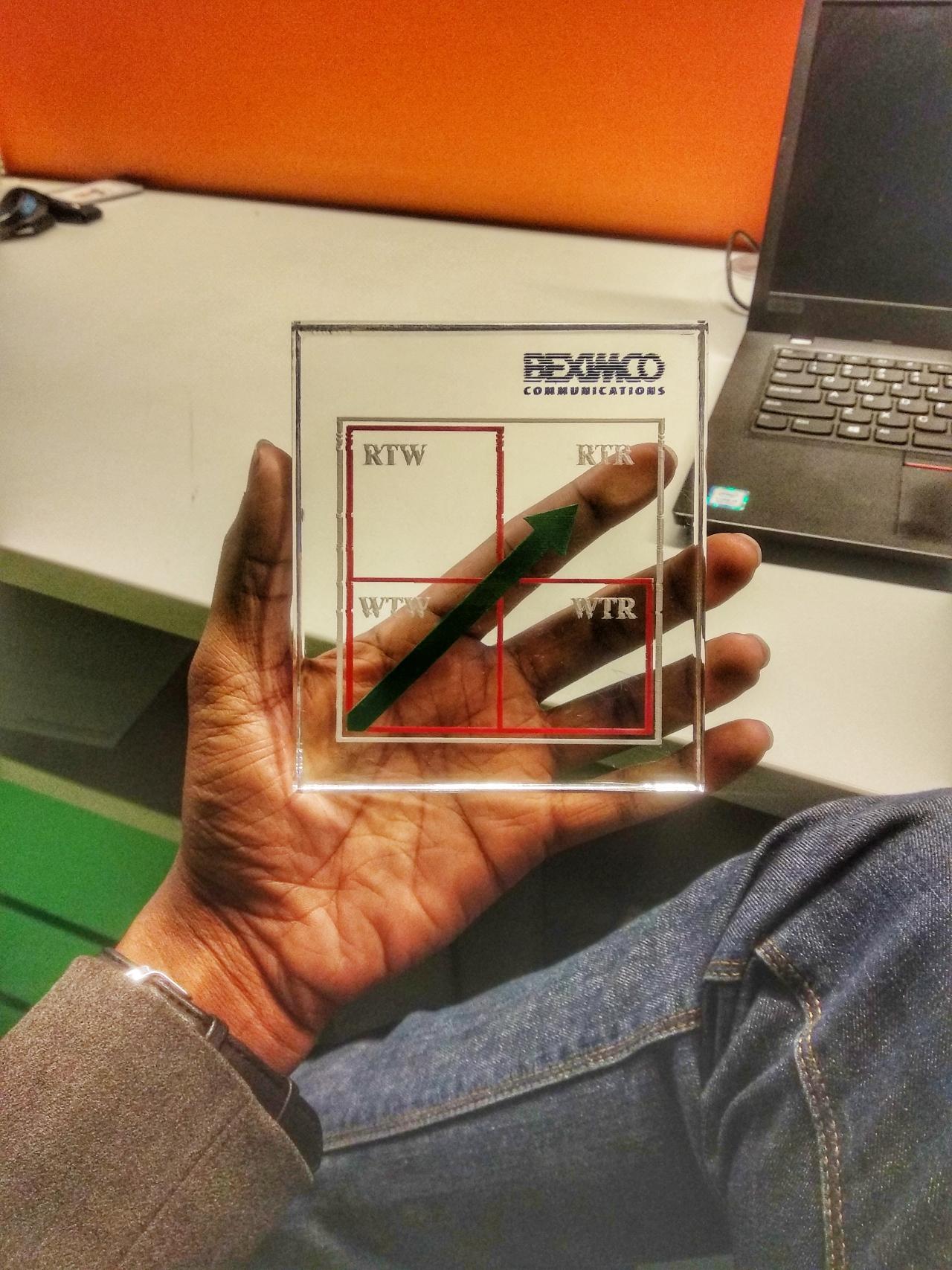
My joining gift at Beximco Communications — an acrylic block with Drucker's 2×2 matrix etched in glass
On my first day at Beximco Communications, I received a small acrylic block as a joining gift. It was elegant — transparent glass etched with a 2×2 matrix and four labels: RTW, RTR, WTW, WTR. I turned it over in my hands not entirely sure what it meant. A colleague leaned over: "Right Thing Wrong. Right Thing Right. Wrong Thing Wrong. Wrong Thing Right."
It took me a moment. Then it hit — this little gift was encoding one of Peter Drucker's most counterintuitive ideas. An idea so sharp it stays with you long after the first reading. An idea that, once understood, changes how you look at nearly every decision you'll ever make.
The Distinction That Changes Everything
Both sound like virtues. Both often are. But they are not the same thing — and confusing them is one of the most expensive mistakes an organisation, a team, or a person can make.
Efficiency asks: How can we do this better? Effectiveness asks: Should we be doing this at all? Drucker was emphatic that effectiveness comes first. You can be spectacularly efficient at doing completely the wrong thing.
"Efficiency is doing things right. Effectiveness is doing the right things. Efficiency without effectiveness is just organised waste."
The Glass Block: A 2×2 That Matters
That acrylic gift wasn't just decorative — it was a framework. Four quadrants. Four outcomes. And one very uncomfortable truth hidden inside them.
The most dangerous cell — the one Drucker most urgently warned against — is WTR: Wrong Thing, Right. Optimising a process that should be eliminated. Building the perfect roadmap to the wrong destination.
The Paradox: Getting Better at Being Wrong
If you are doing the wrong thing and you make a mistake — you may accidentally correct course. A bad result forces a rethink. In an odd way, incompetence in the wrong direction can save you.
But if you are doing the wrong thing and you get better at it — you move further away. You hire people, build systems, invest in tools to do it faster. Every improvement deepens the mistake. Every promotion rewards the wrong direction.
"The righter you do the wrong thing, the wronger you become. It's better to do the right thing wrong than the wrong thing right."
Where This Shows Up in Real Life
Once you see the pattern, you see it everywhere. Here are some examples that are uncomfortably familiar:
- ✗Building a feature nobody asked for — perfectly. The engineering is flawless. The design is beautiful. The user doesn't need it.
- ✗Optimising a process that should be eliminated. Automating a workflow that exists only because of an outdated policy.
- ✗Scaling a business model that doesn't work. Growth hacking a product with poor retention — the more you scale, the more expensive the hole in the bucket.
- ✗Measuring the wrong metric with great precision. A customer service team optimised for handle time, at the expense of actually solving the problem.
- →The contrast: A founder who ships a rough MVP in the right direction — messy, imperfect, but learning — is ahead of the polished roadmap going nowhere.
So What Do You Actually Do?
Ask the effectiveness question before the efficiency question. Before you ask "how do we do this better?" ask "should we be doing this at all?"
This is harder than it sounds. Efficiency is visible — you can measure, track, and reward it. Effectiveness requires stepping back from the work and looking at the work, which often means slowing down before you can speed up.
Some questions worth sitting with:
- ?What problem are we actually trying to solve — and is this the right problem?
- ?If we do this perfectly, does it actually move the needle on what matters?
- ?Are we busy, or are we productive? Are we productive, or are we effective?
- ?Is our efficiency making us better at something we should abandon?
A Glass Block Worth Keeping
That acrylic joining gift still sits on my desk. A transparent square with four letters etched into each corner. But it carries a question worth asking every week, in every role, at every level of an organisation.
Are you in the RTR quadrant — doing the right thing, and doing it well? Or are you somewhere else on that grid, getting more efficient at the wrong destination?
"Mistakes in the right direction are recoverable. Excellence in the wrong direction is how institutions, companies, and careers slowly fail."
The gift was meant to welcome me to a new role. Looking back, it was really an invitation to think differently — about effectiveness before efficiency, about direction before speed, about wisdom before technique. Drucker gave us the framework. The glass block made it tangible.